
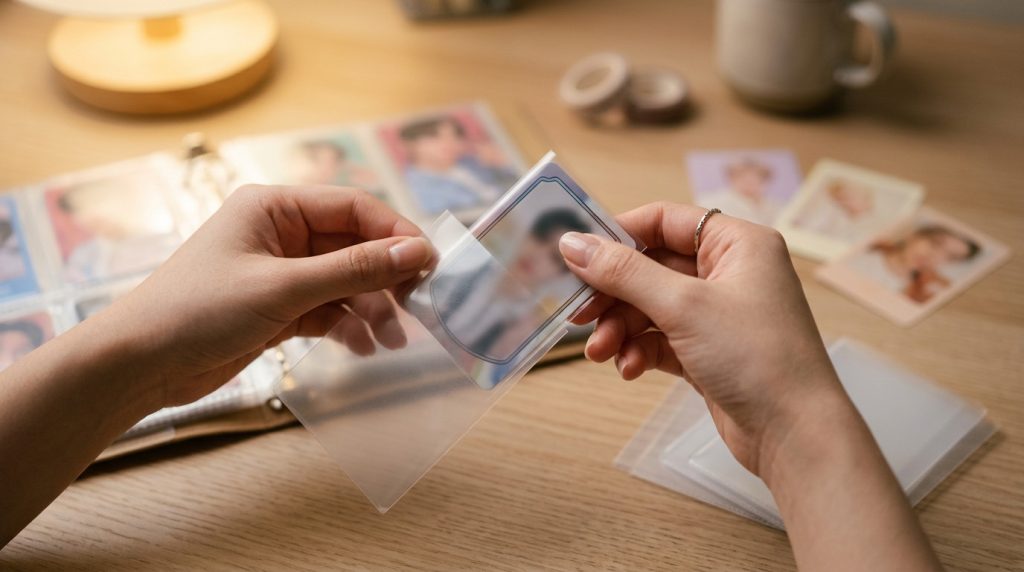
If you’ve been searching for tips on storing K-Pop photocards safely — from choosing the right binder and sleeve material to protecting your collection during international shipping — you’re in the right place.
“I started collecting photocards, and before I knew it, I had three binders… five binders… more than ten.”
Sound familiar? A growing collection brings new challenges:
- You put a card in a binder, but it keeps sliding around or falling out of the sleeve
- After storing cards for a while, the surface became sticky or turned yellow
- A photocard you ordered from Korea arrived bent
→ Don’t worry! With the right binder, sleeve material, and proper storage environment, you can keep your precious collection safe for years to come.
This guide covers everything in one place: choosing the right binder for your photocard size, sleeve material warnings, organization systems, ideal storage conditions, and how to protect your cards during international shipping.
1. Do You Actually Know Your Photocard’s Size? 📏
Before picking a binder or sleeves, the first thing you need to know is the actual size of your photocards. You might be surprised to learn that not all photocards are the same size.
Standard Size
The standard dimension for photocards included in most K-pop albums is 55mm × 85mm (approximately 2.16″ × 3.35″). Major agencies like SM, JYP, HYBE (BigHit), and YG generally use this specification, and sleeve manufacturers typically produce sleeves based on a 56mm × 88mm standard.
ℹ️ Note: Photocard dimensions can vary slightly depending on the agency and album. Measuring your actual cards with a ruler is the most accurate method.
Special Size Variations
Table 1. K-Pop Photocard Size Guide
| Type | Dimensions (mm) | Characteristics | Recommended Sleeve |
|---|---|---|---|
| Standard Album PC | 55 × 85 | Most common, shared across major agencies | 56 × 87mm or 57 × 89mm sleeve |
| Mini Tour PC (HYBE) | 70 × 100 | BTS, SEVENTEEN, TXT mini tour packs | Dedicated sleeve required |
| Japanese Edition PC | 55 × 95 | Slightly taller than standard | 56 × 97mm sleeve |
| Mini ID PC | 35 × 45 | Passport photo–style miniature | Dedicated mini sleeve |
| Postcard | 105 × 148 | A6 size, large inclusions | 2-pocket binder pages |
💡 Tip: If you have special-size photocards, measure them before purchasing sleeves to make sure you get the right fit.
💡 K-pop Album Versions Explained: Regular, Digipack, Weverse, Kit & More
2. Binder Size Selection Guide 📓
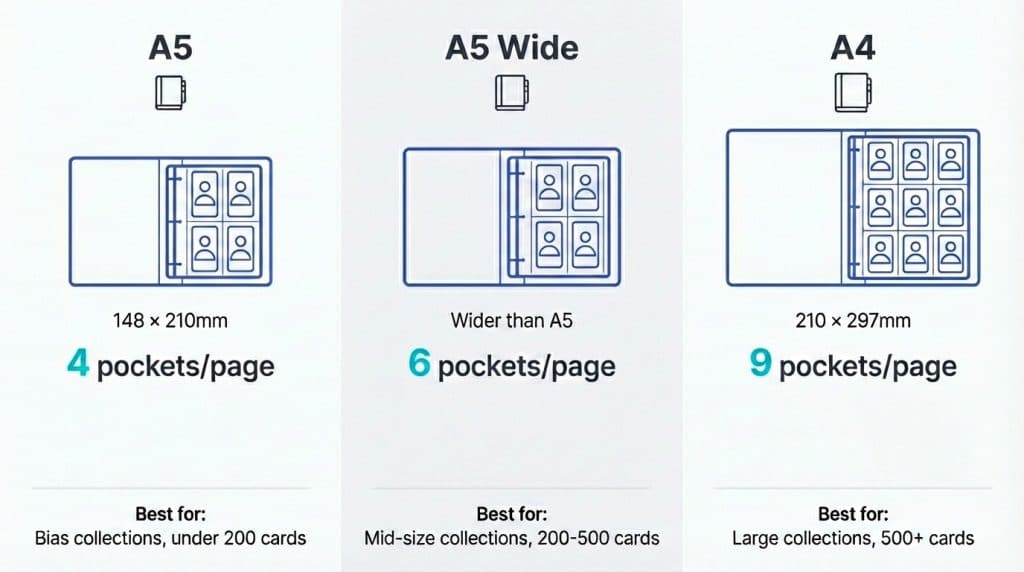
Photocard binders come in three main sizes: A5, A5 Wide, and A4. Your choice will significantly affect storage capacity, portability, and how you organize your collection.
Table 2. Binder Size Comparison
| Feature | A5 (6-Ring) | A5 Wide (6-Ring) | A4 (3-Ring/4-Ring) |
|---|---|---|---|
| Size | 148 × 210mm | Wider than A5 | 210 × 297mm |
| Standard Pages | 4-pocket | 6-pocket | 9-pocket |
| Cards per Page | 4 | 6 | 9 |
| Best For | Bias binders, small collections | Mid-size collections | Large collections, album-based sorting |
| Portability | ⭐⭐⭐ Excellent | ⭐⭐ Moderate | ⭐ Large and heavy |
| Cost Efficiency | Moderate | Moderate | ⭐⭐⭐ Lowest cost per card |
[Image placeholder: Binder size comparison infographic (A5, A5 Wide, A4 binder dimensions and storage capacity comparison)]
Which Binder Should You Choose?
Under 200 cards, collecting a specific member:
→ A5 binder recommended. Compact and perfect for creating aesthetic layouts.
200–500 cards, collecting multiple groups:
→ A5 Wide or A4 recommended. Higher capacity per page makes organizing more efficient.
Over 500 cards, aiming for album completion:
→ A4 binder recommended. 9-pocket pages are the most economical, and PVC-Free options are widely available.
💡 Tip: Many collectors use both A5 and A4 binders — A5 for their bias collection, A4 for their full collection. It’s a great way to stay organized.
3. Sleeve Material: The One Thing You Must Check ⚠️
Just as important as the binder itself is the material of your sleeves (pocket pages). Using the wrong material can cause irreversible damage to your precious photocards.
Why PVC-Free / Acid-Free Matters
Polyvinyl Chloride (PVC) sleeves degrade over time, releasing chemicals in the process. This can lead to:
- Yellowing: The card’s image surface turns yellow
- Sticking: The sleeve bonds to the card, potentially tearing the printed surface when removed
- Oily Residue: PVC breakdown leaves a greasy film on the card
The Safe Choice: Polypropylene (PP)
Choose sleeves made from Polypropylene (PP) or Polyester (Mylar). These materials are chemically inert, meaning they won’t react with your cards over time.
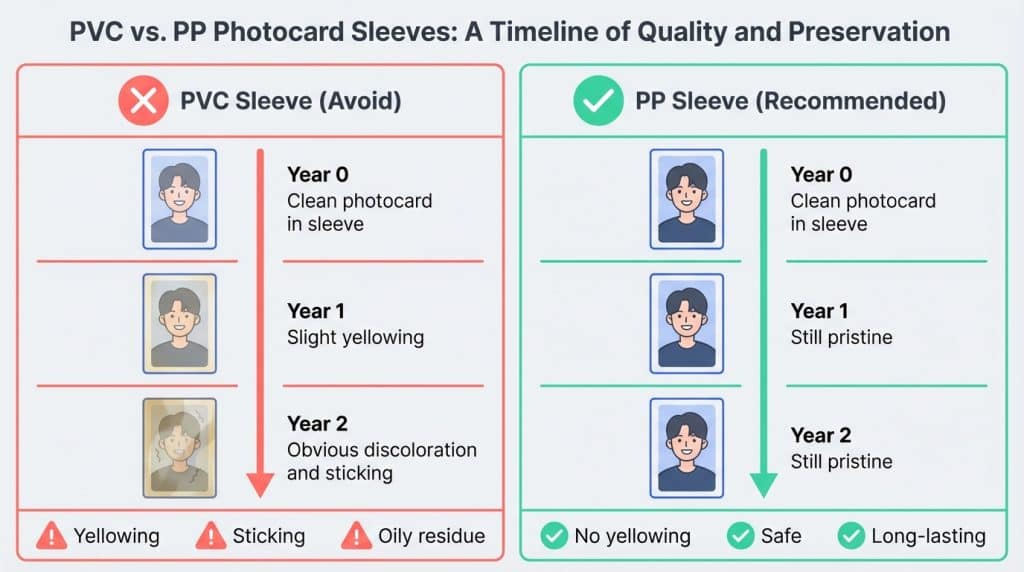
⚠️ Warning: Many cheap binder pages are made from PVC. If the pages have a strong plastic smell, they’re likely PVC. Always check the material label before purchasing.
Sleeve Size Selection
Table 3. Sleeve Sizes for Standard Photocards (55×85mm)
| Sleeve Type | Dimensions (mm) | Purpose |
|---|---|---|
| Inner Sleeve (Fit) | 56 × 87 or 57 × 89 | Close-fitting basic protection |
| Outer Sleeve (Double) | 59 × 92 | Extra protection over inner sleeve (dust & moisture barrier) |
| Toploader | 76 × 102 or larger | Rigid case, essential for shipping |
💡 Tip: For high-value photocards (event cards, fansign cards, etc.), the inner sleeve + toploader combo provides excellent peace of mind.
4. Storage Environment: Watch the Humidity, Temperature, and Light 🌡️
Even the best binder and sleeves can’t protect your photocards if the storage environment is poor.
Ideal Storage Conditions
Table 4. Recommended Photocard Storage Environment
| Factor | Recommended Range | Risks |
|---|---|---|
| Humidity | 30%–50% (Relative Humidity) | Above 60%: Mold, warping / Below 20%: Cracking |
| Temperature | 18°C–21°C (65°F–70°F) | High heat: Accelerates chemical degradation of paper and plastic |
| Light | Avoid direct sunlight | UV light: Ink fading, surface discoloration |
ℹ️ Note: The ranges above are general standards from the photo preservation field. Actual conditions may vary depending on your local climate.
Storage Location Tips
✅ Good Locations:
- Dressers or bookshelves in a first-floor living room or bedroom
- Shaded areas away from direct sunlight
- Indoor spaces with consistent temperature (air conditioning / heating)
❌ Locations to Avoid:
- Attics (can exceed 60°C / 140°F in summer)
- Basements (extreme humidity fluctuations)
- Window ledges (direct sunlight exposure)
- Inside vehicles (rapid temperature changes)
Humidity Management Tips
If you live in a humid climate:
- Place silica gel packets between binder pages to absorb moisture
- Use a dehumidifier to keep indoor humidity below 50%
- Store binders in sealed containers (plastic storage boxes) for added moisture protection
5. Organization Systems: Find What Works for You 📋
Once your collection grows to hundreds of cards or more, a systematic organization method becomes essential. Here are the most popular methods used in the K-pop collector community.
Popular Organization Methods
Table 5. Photocard Organization Methods Compared
| Method | Description | Best For | Pros | Cons |
|---|---|---|---|---|
| By Member (Bias) | All cards of one member, sorted by era/album | Single-member collectors | See a member’s journey at a glance | Binder count grows fast with multiple groups |
| By Album (OT Completion) | All members from one album together | Album completionists | Easy to check set completion | Incomplete sets feel awkward |
| Color Coding | Arranged by background/outfit colors | Aesthetic binder layouts | Visually stunning | Hard to search for specific cards |
| By Rarity | Regular PCs / POBs / Event cards separated | Trading, value management | High-value cards managed separately | Classification can be subjective |
Digital Inventory Tools
If your collection exceeds 500 cards, we recommend pairing a physical binder with a digital tracking tool:
- K-Collect: A photocard-specific tracking app
- PocaAlbum: Wishlist and inventory management
- Google Sheets / Notion Templates: Fully customizable spreadsheets
💡 Tip: Digital inventory tools are especially handy for trading — you can instantly check which cards you own and which you’re looking for.
6. Five Common Mistakes and How to Avoid Them 🚫
Even experienced collectors make these mistakes. Here’s how to avoid them.
❌ Mistake 1: Using PVC Sleeves
Problem: Yellowing, sticking, and oily residue (as explained above)
Prevention: Before purchasing, check for “PVC-Free,” “Acid-Free,” or “Polypropylene” on the label
❌ Mistake 2: Overfilling Your Binder
Problem: Too many pages on the rings creates pressure on nearby cards, leaving “D-ring dents”
Prevention: Fill binders to only 70–80% capacity. If you run out of room, add another binder
❌ Mistake 3: Storing in Attics or Basements
Problem: Extreme temperature and humidity changes cause mold, warping, and discoloration
Prevention: Keep binders in a consistent indoor environment like a living room or bedroom
❌ Mistake 4: Leaving Binders in Direct Sunlight
Problem: UV light causes ink fading and surface discoloration
Prevention: Store binders in drawers or shaded bookshelves; put them back after viewing
❌ Mistake 5: Stacking Cards Without Sleeves
Problem: Card surfaces rub together, causing micro-scratches
Prevention: At minimum, put every card in an inner sleeve
7. How to Receive Photocards Safely from Korea 📦
For international fans, receiving photocards safely from Korea is one of the biggest concerns. Longer shipping distances mean greater risk — but with the right approach, you can protect your cards every step of the way.
Why International Shipping Is Higher Risk
When photocards travel from Korea to your country, they pass through multiple handling points — domestic couriers, international carriers, customs, and local delivery. At each stage, the risk of bending, moisture damage, or surface scratches increases.
The most common types of international shipping damage are:
- Bending: The most frequent issue. Standard thin envelopes alone can’t prevent this
- Water Damage: Rain or condensation seeping into the envelope during transit
- Surface Scratches: Friction from dust or other items in the package
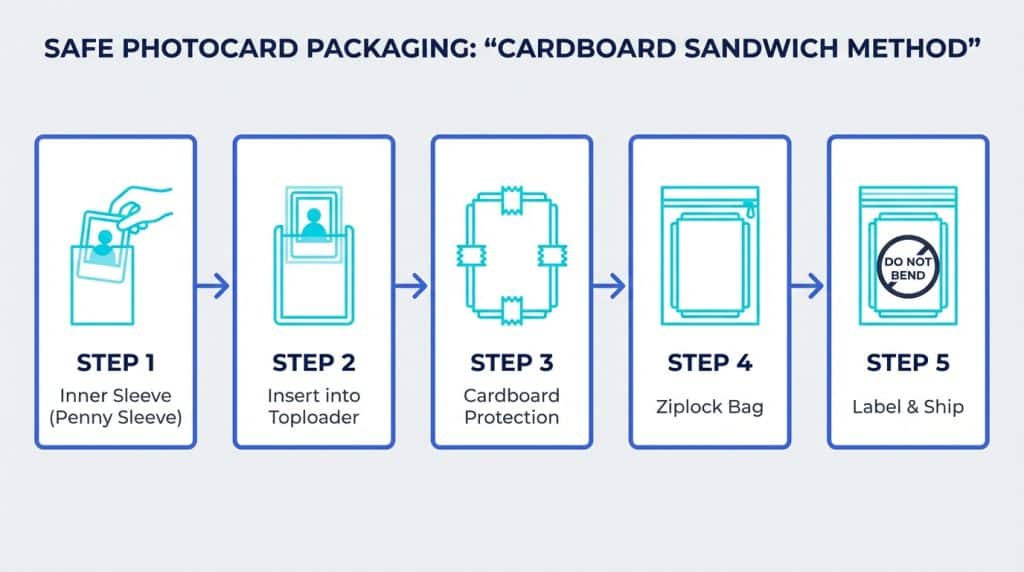
Safe Packaging: The “Cardboard Sandwich” Method
Whether you’re a seller packaging your cards or a buyer requesting specific packaging from sellers, this is the standard method for protecting photocards during shipping:
- Sleeve it: Place the card in an inner sleeve (penny sleeve)
- Topload it: Insert the sleeved card into a rigid toploader
- Sandwich it: Tape the toploader between two sturdy pieces of cardboard
- Waterproof it: Wrap everything in a ziplock bag or waterproof pouch
- Label it: Mark the outside with “Do Not Bend” / “Fragile”
💡 Bunjang vs Twitter/X: Where to Find Rare K-pop Merch Cheaper?
Buying Photocards from Multiple Sellers? Here’s How to Save on Shipping
One of the biggest cost challenges for international fans is paying separate shipping fees for every purchase. If you’re buying photocards from several different sellers in Korea, those fees add up quickly.
Paysable’s Warehouse service solves this problem:
✅ Free storage for up to 1 year: Photocards from multiple sellers are delivered to the Paysable Warehouse first. They’re stored free for up to one year — no rush to ship everything at once.
✅ Save significantly with Consolidated Shipping (합포장): Instead of paying international shipping 10 separate times, store everything at the Warehouse and ship it all in one box. Check your estimated costs with the Shipping Fee Calculator.
✅ Verify your cards with Package Check: Wondering if your photocards arrived safely and in good condition? Use the Package Check service to request photos (₩1,500) or a video (₩5,000) of your items before they ship overseas.
Ready to consolidate your collection? Start storing your photocards at Paysable Warehouse today.
Want to Buy Photocards on Bunjang?
For limited-edition photocards, fansign cards, and trading cards from Korean individual sellers, Bunjang is one of the best marketplaces — but it’s not accessible without a Korean phone number or bank account.
Through Paysable, you can purchase Bunjang products without any of those barriers. Curious how it works? Check out our full guide: How to Buy K-pop Photocards on Bunjang Without a Korean Phone Number (2026 Guide).
Ready to find your next photocard? Browse Bunjang listings directly on Paysable.
For items that are difficult to purchase directly (limited drops, sold-out items), the Manual Purchase service lets a Paysable team member buy them on your behalf.
ℹ️ Note: For detailed information on service fees, please visit the Service Fee page.
8. FAQ ❓
Q. A5 or A4 — Which binder should I buy first?
A. If you’re just starting out, we recommend the A5 binder. It’s compact and great value for beginners. Once your collection grows past 200 cards, adding an A4 binder is the most efficient next step.
Q. Are “Acid-Free” and “PVC-Free” the same thing?
A. Strictly speaking, they’re different, but for photocard storage purposes, they serve a similar function. The key is to check that the material is Polypropylene (PP). PP is naturally both PVC-Free and Acid-Free.
Q. How often can I take my photocards out to look at them?
A. Taking them out to admire is totally fine! Just handle them with clean, dry hands and hold them by the edges. Oils from your fingers can leave marks on the surface over time.
Q. Will Consolidated Shipping mix up or damage my cards?
A. Paysable’s Warehouse stores each package separately. Even during Consolidated Shipping, each package is packed distinctly. If you’re concerned, use the Package Check service to verify the condition of each package before shipping.
Q. What’s the safest shipping method for photocards from Korea?
A. Generally, EMS or K-Packet are reliable options with tracking capabilities. For faster and more secure delivery, UPS or DHL are solid choices, though they come at a higher cost. Available carriers vary by destination country, so check the Warehouse guide for details.
Q. Can I store photocards I bought from different sellers together at the Warehouse?
A. Yes! That’s one of the main advantages of Paysable Warehouse. Items from multiple sellers are stored separately under your customer code, and you can request Consolidated Shipping whenever you’re ready. This is particularly useful when collecting photocards from several different album releases or individual sellers at the same time. Planning a haul from multiple comebacks? Read our K-Pop Comeback Schedule Guide: Pre-Order vs Release Day to plan your timing.
9. Your Photocard Storage Checklist ✅
Here’s a summary of the key takeaways from this guide:
- [ ] Sleeve material check: Is it PVC-Free / Acid-Free / Polypropylene (PP)?
- [ ] Binder size selected: Did I pick the right A5 or A4 for my collection size?
- [ ] Overfill prevention: Am I only filling to 70–80% capacity?
- [ ] Storage environment: Humidity 30–50%, temperature 18–21°C, no direct sunlight?
- [ ] Shipping protection: Sleeve → Toploader → Cardboard sandwich → Waterproofing?
- [ ] Bulk buying strategy: Am I using Paysable Warehouse for Consolidated Shipping?
Your photocard collection is more than just paper cards — they’re a special connection to the artists you love, your own personal record of the moments that matter.
Protect that collection with the right storage methods, and keep it safe for years to come! 💜
Have questions? Check the FAQ or reach out through 1:1 Inquiry.
Related Articles:
- 5 Ways to Save on K-pop Album International Shipping
- How to Pre-Order K-Pop Albums from Overseas
- K-pop Merch & Customs Tax Guide: Duty-Free Limits by Country
- K-pop Photocard Trading Guide for Beginners