
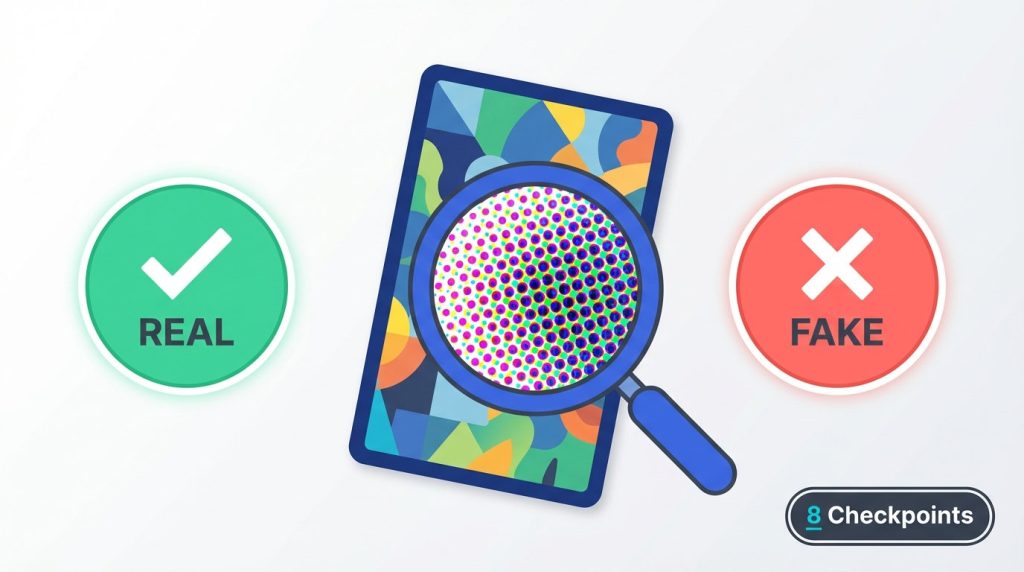
“It looks different from the official photos — did I receive a lomo card?”
If you don’t know how to identify fake K-pop photocards, this question is hard to answer on your own. International fans especially face a unique challenge: there’s no opportunity to physically inspect a card before it arrives, meaning the moment it’s delivered is often the first chance to verify its authenticity.
→ This guide will help. From physical checkpoints to platform-specific risks and practical verification methods for international fans — everything you need, with concrete criteria.
🔍 First, What Is a “Lomo Card”?
Originally, “lomo cards” were fan-made goods — created and handed out by fans at conventions. No one claimed they were official. But as the K-pop photocard secondary market grew, the meaning of this term changed completely.
Today in fandom, “lomo card” refers to unauthorized replicas made to look like official photocards. Mass-produced by manufacturers in China and distributed through AliExpress, Taobao, and similar platforms, they spread through the international fan community when deceptive resellers pass them off as genuine.
In October 2024, Busan Customs prosecuted a smuggler who attempted to import approximately 1.23 million counterfeit photocards from China. A 55-card set cost just 400–1,000 KRW to produce — less than 10 KRW per card. Between 2024 and August 2025, customs authorities seized 713,593 fake IVE photocards alone. These numbers speak for themselves.
⚠️ Note: Customs seizure figures represent only what was intercepted. The actual scale of distribution may be significantly larger.
✅ 8 Checkpoints for Identifying Genuine Photocards
1. Size and Weight
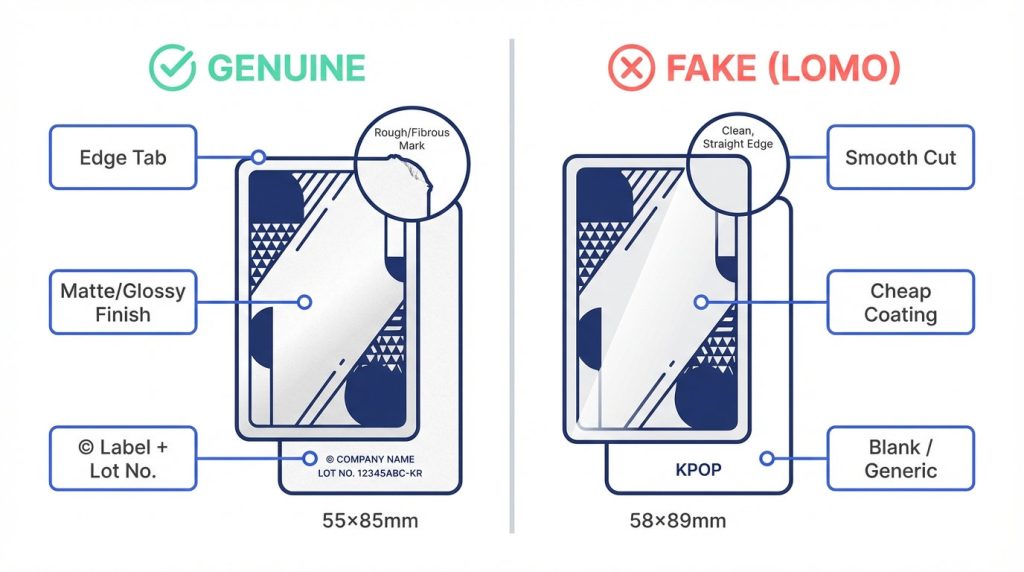
This is the easiest place to start. Genuine photocards measure 55 × 85mm (some die-cut variations fall within a 54 × 86mm tolerance), and weigh approximately 1.8–2.2g. Lomo cards are typically 58 × 89mm — 3–4mm larger in both dimensions.
This may sound like a small difference, but it becomes visible when you place the card in a photocard binder or next to other cards. If you have a precise scale, check the weight too. Official cards use thick paper at 300gsm or above, while lomo cards often use standard photo paper (200–260gsm), making them feel noticeably lighter and thinner in hand.
2. Paper Texture and Thickness
One counterintuitive fact: Based on experiences shared in Korean collector communities (such as Namu Wiki), scan-replicated fake cards can actually feel stiffer and thicker than genuine ones. Manufacturers trying to compensate with heavier paper end up producing cards that are too rigid. Genuine cards have a moderate flexibility with a slightly resistant finish that you can feel at your fingertips.
3. Edge Tab (Die-Cut Mark)
This is one of the most reliable physical indicators of a genuine photocard. When large sheets are cut by industrial die-cutting machines at the factory, tiny paper fibers or marks are left along the card edges. This is especially noticeable on SM Entertainment cards (aespa, NCT, etc.), where these marks appear clearly on the top and bottom edges.
Lomo cards, by contrast, are individually cut, resulting in perfectly straight, smooth edges. If a card you believe is genuine is missing these marks, proceed with caution.
ℹ️ Important: Judging by corner shape (roundness) alone can be misleading. Corner treatment can vary depending on print placement within the same album. For example, ATEEZ’s Treasure Epilogue: Action to Answer album has different corner shapes and tab positions across its first print run, second print run, and platform-specific versions. Always cross-check multiple criteria rather than relying on corners alone.
4. Finish Characteristics by Label
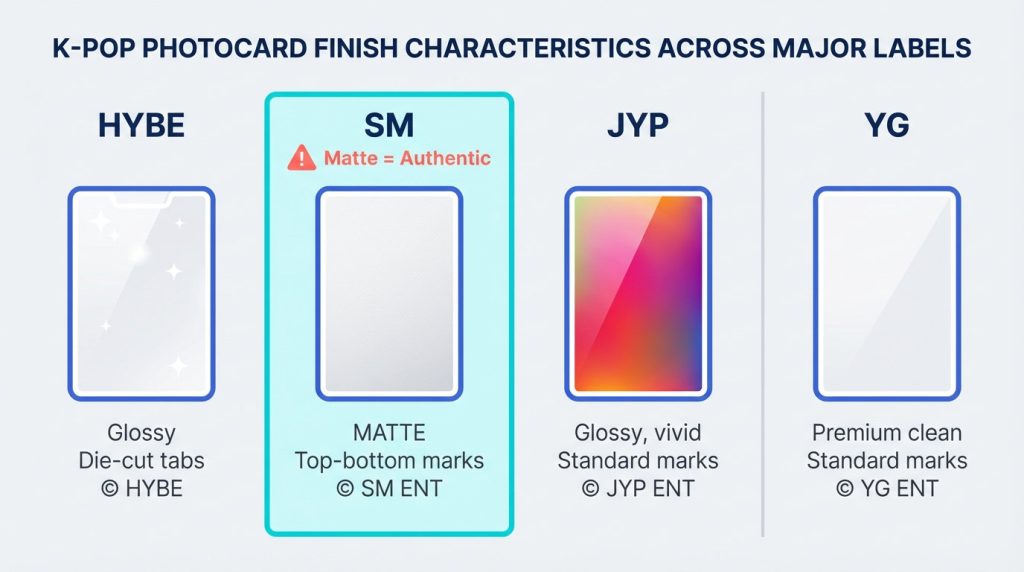
Table 1. Photocard finish characteristics by major label
| Label | Surface Finish | Edge Features | Back Text | Notable Points |
|---|---|---|---|---|
| HYBE (BTS, SEVENTEEN, NewJeans) | Glossy | Die-cut tabs present | “© BIGHIT MUSIC” or “© HYBE” + album title | Holographic logo on lucky draw cards |
| SM (NCT, aespa, RIIZE) | Matte | Protruding marks on top/bottom edges | “© SM ENTERTAINMENT” + lot number | Up to ~50 card variations per album; matte texture is key |
| JYP (Stray Kids, TWICE, ITZY) | Glossy, high saturation | Standard die-cut marks | “© JYP Entertainment” + album identifier | Thick paper stock, vivid colors |
| YG (BLACKPINK, TREASURE) | Premium clean | Standard die-cut marks | “© YG Entertainment” | Fewer card types; some holographic elements |
SM’s matte finish is a particularly important benchmark. If an SM card that should be matte instead has a cheap, shiny coating, that alone is a strong warning sign.
5. Image Crop and Framing
Counterfeit card manufacturers can’t access original high-resolution files, so they scan official cards and reprint them. In this process, the image is slightly enlarged or cropped relative to the original. If an artist’s hand or shoulder reaches to the card edge, the genuine version should have some background space around it.
K-Collect (kcollect.net) has a database of over 100,000 photocards. If you’re unsure about a card, compare the image crop directly with official references on the site. Also note that copyright text and label logos at the bottom of fake cards are often blurry and pixelated due to degraded scan quality. Genuine photocard text maintains the crispness characteristic of industrial offset printing.
6. Back Design
This is where fake cards fail most often. Genuine photocards have label copyright text, album-related design elements, and sometimes lot numbers or partial barcodes printed on the back.
Watch out for these signs:
- ❌ The back is completely white or has only a generic “KPOP” label
- ❌ Font weight or letter spacing differs from the official card
- ❌ Label logo or text alignment is misaligned or skewed
7. Camera Test & Flash Video
Camera Test: Switch your smartphone to macro mode and take a close-up photo of the card surface. Genuine cards will show CMYK rosette dot patterns (regular dot arrangements) characteristic of industrial offset printing. Inkjet replicas show random dot-spray patterns; laser replicas show toner particle patterns. No special equipment needed — your smartphone alone can reveal differences in printing method.
Flash Video: Before a P2P transaction, ask the seller to record a short video of the card under flashlight, shot from multiple angles. This method reveals surface scratches, print quality differences, and hologram irregularities that don’t show up in regular photos. Reliable sellers will generally comply with this request.
8. Price Red Flags
The price tells you something. If someone’s selling a 55-card set for 5,000 KRW — that’s not genuine. You can’t buy a single authentic photocard at that price. Products described as “30–55 card sets,” “LOMO card sets,” or “custom photocards” are, by definition, unauthorized replicas.
On the other end of the spectrum, rare cards can command serious prices — a BTS Jungkook Butterful Night lucky draw card has been recorded selling for approximately 4.3 million KRW. The counterfeiting incentive grows significantly with card value. The higher the price, the more carefully you should apply the checkpoints above.
🌍 The Realities International Fans Face
Domestic fans can inspect cards in person before completing a transaction. But international fans have no way to physically verify a card until it arrives at their door. Two additional risks compound this:
Dispute Window Timing: Bunjang’s escrow (BunjaePay) auto-confirms transactions within 3 days of delivery. When using a proxy service, “delivery” is counted from when the package arrives at the proxy warehouse — not when it reaches you internationally. By the time you hold the card in your hands for the first time, the dispute window may already be closed.
Proxy Service Policy Differences: Some services explicitly disclaim authenticity guarantees. When choosing a service, check whether it provides physical photos after warehouse arrival or offers inspection options.
Package Check: Verify Before It Reaches You
Paysable’s Package Check Service is a practical solution to fill this gap. After a card arrives at the Korean warehouse and before international shipping, you can have the actual item documented via photo (1,500 KRW) or video (5,000 KRW).
ℹ️ Note: Service fees are subject to change. Check the Service Fee page for current rates.
If you suspect a fake, request a video — a video shot from multiple angles can serve the same purpose as the flash video method in checkpoint 7 above. If something looks off, you can take action before international shipping, which is far easier than negotiating a return after the package has already arrived.
🛒 Where Is It Safer to Buy?
Table 2. Risk level by photocard purchasing channel
| Platform | Risk Level | Notes |
|---|---|---|
| AliExpress / Taobao / Temu | 🔴 Very High | Source of lomo card distribution. No genuine cards available |
| Twitter/X | 🔴 High | No buyer protection. Scams concentrated on weekends/evenings (Korean time) |
| eBay | 🔴 High | High counterfeit rate for expensive lucky draw and fansign cards |
| Bunjang (direct transaction) | 🟡 Medium | Use BunjaePay escrow + be mindful of the 3-day dispute window |
| Pocamarket | 🟢 Low | AI trained on 300,000+ patterns + expert review before listing |
| Official stores (Ktown4u, Weverse, etc.) | 🟢 None | Guaranteed authentic, official distribution channels |
⚠️ Note: Platform policies and conditions are subject to change. Check each platform’s current terms before transacting.
If buying on Bunjang, check the seller’s bank account number or phone number on The Cheat (더치트) for any reported fraud history first. For a detailed guide to buying photocards on Bunjang, see The Complete Guide to Buying K-pop Photocards on Bunjang.
If you’d like to compare which platform suits your collecting style better, Bunjang vs Twitter/X: Where to Buy Rare K-pop Merch is also worth a read.
❓ Frequently Asked Questions
Q. What should I do if I receive a fake card?
A. Don’t message the seller first. Fraudulent sellers sometimes use direct conversation to pressure buyers into confirming the transaction. Instead, report directly to the platform’s customer support. Submitting comparison photos with a genuine card, your receipt, and packaging photos will improve your chances of a successful refund. If you paid via PayPal Goods & Services, you can file a dispute within 180 days.
Q. I suspected a lomo card and asked for a flash video, but the seller refused.
A. Trustworthy sellers generally don’t decline verification requests. A refusal itself may be a red flag. We recommend pausing the transaction and looking for another seller.
Q. I don’t have a Korean phone number, so it’s hard to buy directly on Bunjang. What can I do?
A. How to Buy K-pop Photocards on Bunjang Without a Korean Phone Number walks you through the process step by step.
Q. I’ve heard POB and lucky draw cards have a higher counterfeiting risk?
A. That’s right. The higher a card’s value, the greater the counterfeiting incentive. If you’re not yet familiar with K-pop terminology, K-pop Fandom Terms Explained: What Do POB, PC, SG, GO Mean? is a good place to start.
Q. How should I store my photocards properly?
A. Once you’ve confirmed a card is genuine, storage matters too. Direct sunlight and humidity can damage cards. For detailed storage tips, check out The Complete Guide to Proper K-pop Photocard Storage.
💡 Quick Checklist
Run through these before making a purchase:
- [ ] Card size: Not significantly different from the 55 × 85mm standard?
- [ ] Edge tab: Are there faint die-cut marks along the edges?
- [ ] Surface finish: Does the finish match the label? (SM → matte, HYBE/JYP → glossy)
- [ ] Back design: Is the copyright text and album design clearly printed?
- [ ] Image crop: Does the crop match the K-Collect database reference?
- [ ] Price signals: Is it a bulk set, or suspiciously cheap?
- [ ] Seller check: Have you searched for fraud history on The Cheat or similar?
- [ ] Flash video: Have you received a multi-angle video before buying?
For international buyers, the surest method is to use Package Check after the card arrives at the warehouse — before it ships internationally.
For a broader look at how photocard trading works, The Beginner’s Guide to K-pop Photocard Trading is also worth reading.