
“I know my bias’s photocard is out there somewhere in the world — but I have no idea how to get it…”
If you’ve been searching for a K-pop photocard trading guide, you’ll relate to this feeling more than anyone. The disappointment of opening an album and finding someone else’s card, the excitement mixed with helplessness of spotting a rare card sold only by a Korean seller — these are emotions every fan feels when stepping into the world of photocard trading.
→ Don’t worry! Millions of K-pop fans around the world are already actively buying, selling, and trading photocards. Once you know the terminology and process, it’s easier than you think. In this guide, we’ll walk you through everything step by step, from beginning to end.
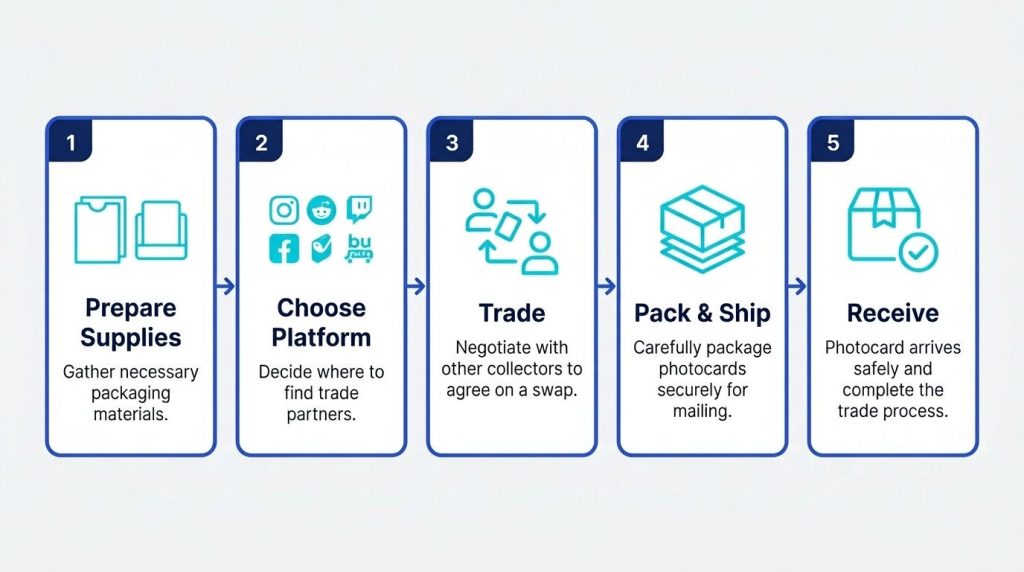
📋 Before You Start Trading: Essential Supplies
In photocard trading, a card’s condition is its value. Even a tiny scratch or a bent corner can drop a card from Near Mint to Damaged. You need to store cards correctly from the moment you receive them to preserve their condition. The supplies below are needed immediately upon receiving cards, and you’ll use them again when you become a seller and ship cards out.
Basic Protective Supplies
| Supply | Role | What to Watch Out For |
|---|---|---|
| Inner Sleeve (Penny Sleeve) | Protects the card surface from dust, oils, and friction | Must be Acid-free and PVC-free. PVC materials can cause ink discoloration and sticking over time |
| Toploader | Provides a rigid outer shell to prevent bending and creasing | Choose the right size for standard photocards (approx. 55×85mm) |
| Washi Tape | Seals the toploader opening and secures packaging | Regular clear tape leaves residue that can damage cards — always use washi tape |
| Cardboard | Adds an extra protective layer around the toploader | Essential for international shipping. Use a size larger than the toploader to absorb corner impacts |
Photocard protective supplies — inner sleeve, toploader, washi tape, cardboard
ℹ️ Note: Sleeve brands commonly recommended by the community include Dragon Shield, Popcorn Games, and KMC Perfect Mini. Some photocards — such as Japanese editions or Mini ID cards — come in different sizes, so check the card dimensions before purchasing.
For more details on storing and caring for photocards, check out our Photocard Storage Guide.
🌐 Where to Trade? A Guide to Each Platform
The K-pop photocard trading ecosystem is broadly divided into SNS-based P2P (peer-to-peer) trading and dedicated marketplaces. Understanding the pros and cons of each platform will help you choose the right trading method for you.
SNS-Based Trading Platforms
Instagram
Instagram is the most widely used platform among Western and global collectors. Its image-focused interface suits photocard trading well, and the Highlights feature lets sellers pin past successful trade records (Proofs) to their profile as a key trust signal.
Due to recent algorithm changes, hashtag searches have become less effective, so the community has adopted the Tag Account method. Group-specific aggregator accounts like @illittags and @dalsotags are operated by fans, and sellers tag these accounts so buyers can browse real-time inventory through the account’s “Tagged Photos.”
Twitter (X)
Twitter accounts for a significant portion of trading in Southeast Asia and South Korea. Its chronological feed means prices form quickly and trading is active right after new album releases. However, the high degree of anonymity and unstructured profiles mean scam risks are relatively higher.
Reddit (r/kpopforsale)
Trading volume is lower, but strict moderation rules apply. The most notable is the Physical Timestamp rule, which requires sellers to photograph their photocards alongside a handwritten note with their username and the date. This provides a relatively safe environment for high-value trades or beginners trading for the first time.
Dedicated Marketplaces
Pocamarket
A K-pop photocard-dedicated app where sellers ship their cards to the Pocamarket warehouse in Korea, and the platform verifies authenticity before listing begins. The key advantage is being able to purchase certified cards without the uncertainty of P2P trading. Two versions of the app are available — one for domestic Korea use and one for global users.
Korean Domestic Marketplace: Bunjang
Bunjang is Korea’s largest secondhand trading platform and has the most diverse inventory of rare cards, broadcast-exclusive cards, and Pre-Order Benefit (POB) cards — often at the most competitive prices.
However, Bunjang requires a Korean phone number, has a Korean-language interface, and payment often requires domestic Korean bank transfers, making it difficult for international fans to use directly. That’s why international fans turn to proxy services.
For a detailed guide on purchasing photocards from Bunjang, check out our Complete Guide to Buying K-pop Photocards from Bunjang Overseas.
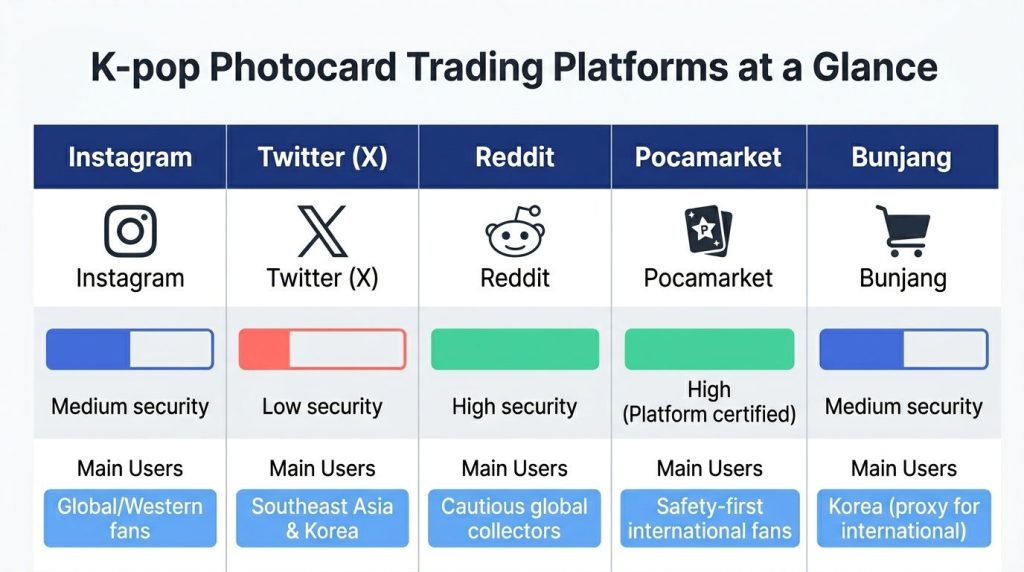
Table 1. K-pop Photocard Trading Platform Comparison
| Platform | Trading Method | Security Level | Main Users | Key Feature |
|---|---|---|---|---|
| P2P, image-based | Medium (Proofs system) | Western & global fans | Tag Account search, Highlights for Proofs | |
| Twitter (X) | P2P, text & image | Low | Southeast Asia & Korea | Fast trading speed, active after new releases |
| P2P, forum-based | High | Cautious global collectors | Physical timestamp required, strict moderation | |
| Pocamarket | Intermediary platform | High (platform-certified) | International fans seeking safety | Authenticity verification before listing, global shipping |
| Bunjang | P2P, Korean domestic | Medium | Korea domestic (international via proxy) | Largest inventory, lowest prices, not directly accessible overseas |
⚠️ Note: Platform policies and features may change at any time. It’s a good idea to check the latest guidelines on each platform before trading.
🗣️ Essential Trading Terminology
The K-pop trading community uses abbreviations and standard terms so fans around the world can communicate without a language barrier. Here are the key terms to familiarize yourself with before you start trading.
Table 2. K-pop Photocard Trading Essential Terminology
| Term | Meaning |
|---|---|
| PC | Short for Photocard |
| WTS / WTB / WTT | Want To Sell / Want To Buy / Want To Trade — used to express selling, buying, or exchange intent |
| ISO | In Search Of — used when listing a card you’re looking for |
| POB | Pre-Order Benefit — a limited photocard provided when purchasing from specific shops before release. Generally commands a higher market price than regular album cards |
| Pulls / Dupes | Pulls are the cards you get when opening an album; Dupes are the duplicate ones among them |
| NM / SP / LP | Near Mint / Slightly Played / Lightly Played — card condition grades |
| Proofs | Photos or videos proving past successful trades. A key indicator of a seller’s trustworthiness |
| DWAYOR | Deal With At Your Own Risk — a warning tag for sellers with a history of scamming |
| GOM / GO | Group Order Manager / Group Order — a collective buying system where multiple fans pool orders to purchase from Korea at once |
| Lomo | Unofficial fan-made cards. They have no official market value, so make sure to identify them when purchasing |
| n:1 | Trade ratio. For example, 3:1 means trading 3 lower-value cards for 1 higher-value card |
🔄 How Trading Works: A Step-by-Step Workflow
P2P photocard trading follows systematic steps. Understanding each stage will reduce anxiety and help you trade safely.
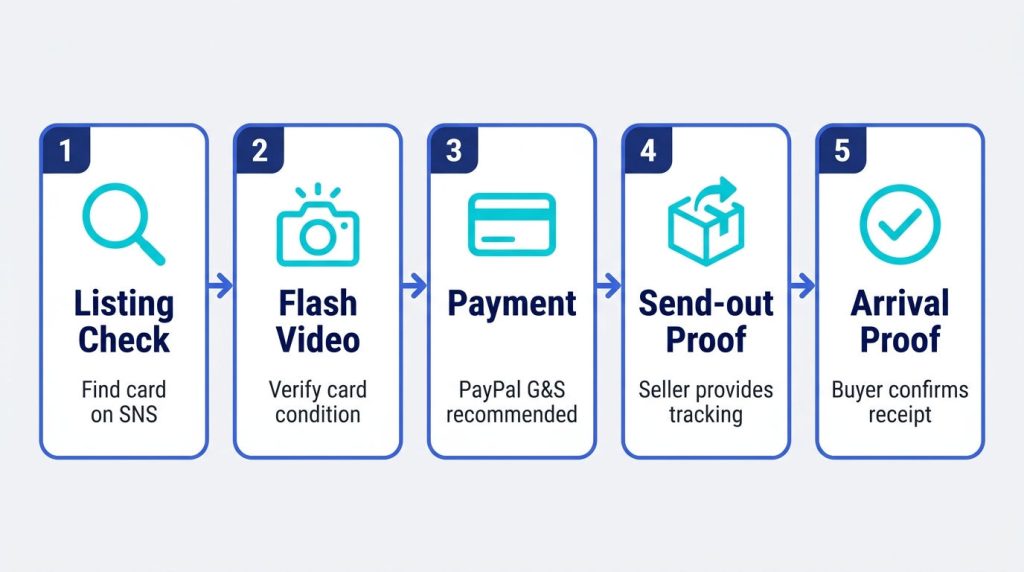
Step 1: Check the Listing and Make Contact 📋
When a seller posts a photocard on SNS, they use standard abbreviations.
[WTS] SEVENTEEN GOING Magazine - Vernon PC
NM, $15 shipped (US only)
DM for Proofs
When you find a card you want, reach out via DM (Direct Message).
Step 2: Verify Condition — Flash Video Exchange 🔍
This step is the most important part of trading. Both buyer and seller exchange Flash Videos. This means turning on your smartphone flashlight and recording a short video of the photocard tilted at various angles.
Hairline scratches and imprint marks that aren’t visible in regular photos appear clearly under a flash, making Flash Video the de facto standard method for verifying card condition.
What to check:
- Hairlines on the card surface (fine linear scratches — caused during factory packaging)
- Imprints (indentation marks — caused by album CD hubs or plastic frames pressing against the card)
- Corner condition and any color fading
💡 Tip: Due to inconsistent quality control from entertainment companies, “Mint” condition is often effectively unachievable for K-pop photocards. Near Mint (NM) is considered the best realistic condition. The most important thing is that both parties communicate honestly about condition before trading.
Step 3: Payment 💳
The choice of payment method is central to trade safety. We’ll cover this in detail in the safe trading section below.
Step 4: Send-out Proof 📦
After shipping, the seller must provide proof of shipment to the buyer.
- Standard mail: Film a video of dropping the envelope into a mailbox
- Registered mail / courier: A photo of the receipt with tracking number, or a video of handing it over at the post office counter
Step 5: Arrival Proof ✅
When the buyer receives the card, they post an Arrival Proof. They photograph the received card, post it to their Instagram Story or Twitter, and tag the seller — who then adds it to their own Proofs.
These Proofs serve as the seller’s reputation and credit score.
🛡️ How to Avoid Scams: Safe Trading Guide
In the decentralized SNS trading environment, scams are unfortunately a realistic threat. Knowing the common types of scams and how to prevent them in advance will help you avoid most risks.
Common Types of Scams
- Counterfeit Cards: Fake cards reproduced from high-resolution scans. Most common with old out-of-print cards or high-value POB cards.
- How to spot them: Check if the image cropping matches the official card exactly, if the corner curvature looks natural, and if the color saturation is normal. Be suspicious of prices significantly below market value.
- Ghosting: A seller accepts payment, makes excuses for shipping delays, then cuts off contact. Some cases involve sellers continuing to post new listings without deleting their profile.
- Selective Scamming: The most insidious type — building a solid collection of Proofs through many successful small-value trades, then scamming in a high-value transaction.
Pre-Trade Checklist
✅ Always check the seller’s Proofs — verify they are recent and that tagged accounts are actually active
✅ Check community blacklists — search the seller’s name or payment info on DWAYOR tag accounts on Twitter or Carrd-based blacklist sites
✅ Look up account numbers in scam databases — when trading with Korean sellers, check accounts on sites like The Cheat (더치트)
💳 Choosing a Safe Payment Method
| Payment Method | Safety | Description |
|---|---|---|
| PayPal Goods & Services (G&S) | ✅ High | Disputes and refunds available for non-delivery or misrepresented items. The standard for international transactions |
| PayPal Friends & Family (F&F) | ⚠️ Low | All buyer protection is removed. Scammers often request F&F, so be cautious |
| Concealed Cash (CC) | ❌ Very Dangerous | Sending cash in an envelope — untraceable and at high risk of theft. Strongly discouraged by the community |
⚠️ Note: Payment methods and related policies may change. We recommend checking the latest terms before transacting.
✈️ Packaging and Shipping: How to Send Cards Safely
Photocards may be small and light, but they can get creased or bent passing through the automated sorting machines of international postal services. The community uses a standard packaging method known as the “Cardboard Sandwich.”
Standard Packaging Method: Cardboard Sandwich
- Inner sleeve: Place the photocard in a sleeve to protect the surface
- Toploader: Insert the sleeved card into a toploader for structural rigidity
- Seal the toploader: Seal the top opening of the toploader with washi tape
- Cardboard sandwich: Place the toploader between two pieces of cardboard and secure with washi tape
- Insert into envelope: Place the completed package in an envelope and ship
💡 Tip: If you don’t follow this packaging standard, even if the card arrives intact, it can seriously damage your reputation as a seller. Proper packaging is also an act that shows trustworthiness.
🌍 How to Receive Korean Photocards from Abroad
One of the biggest challenges for international fans is shipping. Receiving items directly from Korean sellers to an international address can be costly and limited in options.
The Limits of Direct International Shipping
- Standard mail: Affordable at $1-2, but no tracking and risk of loss
- K-Packet: Since the COVID-19 era volumetric weight policies were implemented, shipping costs for K-pop merchandise that is light but bulky have risen significantly
- EMS / DHL / UPS and other express services: Fast and secure, but cost-prohibitive for small individual trades
In particular, when collecting photocards one by one from multiple sellers, paying separate international shipping fees for each can result in shipping costs exceeding the card price itself.
💡 The Solution: K-Addy (Korean Address Service) and Consolidated Shipping
The method widely used by international fans to solve this problem is the K-Addy (Korean Address) — a Korean proxy/forwarding service.
How it works:
- When you sign up for a proxy service, you receive a Korean domestic address
- You ask Korean sellers to ship to this address
- Photocards arrive at the proxy’s Warehouse for storage
- When multiple photocards have accumulated, they’re consolidated into one box for international shipping
The key advantage of this method is shipping cost savings. Compared to receiving items from 10 different sellers individually, consolidating and shipping once dramatically reduces the per-item shipping cost.
Paysable Warehouse: The Best Choice for Photocard Collectors
Paysable is a specialized platform that provides international K-pop fans with a Korean address, warehouse storage, and consolidated shipping services.
Special advantages for photocard traders:
- Up to 1 year of free storage: No need to rush and ship everything at once — you can request shipping whenever you’re ready, after accumulating enough cards. Given that trading involves cards arriving from various sellers at various times, long-term free storage is a major benefit.
- Consolidated Shipping: Combine multiple packages into one to significantly save on international shipping costs.
- Package Check Service: Before international shipping, the warehouse opens your package and provides photos or video of the contents. If the wrong card arrived or there’s a condition issue, you can resolve it domestically before paying expensive international shipping fees.
- Bunjang Integration: You can search and purchase Bunjang items directly within the Paysable site, giving you access to Bunjang’s vast photocard inventory without needing a Korean phone number or bank account.
- Direct Payment: When a Korean seller requires a domestic bank transfer, Paysable’s Direct Payment service enables overseas buyers to send Korean bank transfers from abroad.
If you want to know shipping costs in advance, you can check in real time with the Shipping Fee Calculator.
❓ FAQ
Q. What if I don’t have any Proofs when I trade for the first time?
A. Most sellers and traders also started without any Proofs. It’s common to start with small-value trades and gradually build trust. Starting on certified platforms like Pocamarket or in strictly-moderated communities like Reddit’s r/kpopforsale allows you to trade relatively safely even without Proofs.
Q. I find it difficult to communicate directly with Korean sellers — is there another way?
A. You can use Paysable’s Manual Purchase service for communication and purchasing from Bunjang sellers. Simply provide the item information and the Paysable team will handle the purchase on your behalf.
Q. Do I need to use professional card grading services like PSA or BGS?
A. Professional grading services are generally not recommended within the K-pop photocard community. K-pop photocards have inconsistent quality control from entertainment companies, meaning card materials and corner finishing can differ even within the same album. The Flash Video direct verification method between individuals has become the community standard.
Q. Isn’t shipping expensive when collecting photocards from multiple sellers?
A. You can use a forwarding service with consolidated shipping, like Paysable Warehouse. Accumulate multiple photocards at the warehouse and ship them all at once — it significantly reduces shipping costs compared to individual shipments. Since Paysable offers free storage for up to 1 year, you can build your collection at your own pace without time pressure.
✨ Wrapping Up
K-pop photocard trading can seem complex at first, but when you break it down, it’s straightforward.
Key Takeaways:
- 📋 Gather your supplies: Inner sleeve, toploader, washi tape, and cardboard are the basics
- 🌐 Choose the right platform for you: Pocamarket or Reddit for safety, Instagram or Bunjang for variety
- 🔍 Verify card condition with Flash Video: The most important step in any trade
- 💳 Pay with PayPal G&S: Use a payment method with buyer protection
- ✈️ Save on shipping with consolidation: Use a Korean address (K-Addy) service to accumulate multiple cards and ship at once
Ready to start your first trade with confidence? Join Paysable to get a Korean address, with warehouse storage, consolidated shipping, and direct Bunjang purchasing — all in one place.