
In August 2014, TAEMIN’s first solo mini album ACE was released. The title track “Danger” was written by producer Thomas Troelsen, the lyrics came from Seo Ji-eum, and the choreography was built by American choreographer Ian Eastwood. The Korean music webzine izm wrote at the time that “his name appears nowhere in the writing or composing credits, yet he took full command of the record through song selection that suited his tone and vocal delivery that fit it.” For a first solo album, that was a generous review. But what it pointed to was what he chose and how he sang it, not what he wrote.
Twelve years later, in April 2026, he stood on the Mojave Stage at Coachella in Indio, California. He was the first Korean male solo artist to perform an official set at the festival. Across roughly 50 minutes, he sang six of his own songs that had not yet been released: “Permission,” “Parasite,” “Frankenstein,” “Let Me Be the One,” “Sober,” and “1004.”
This TAEMIN review begins at something as small as a credit line because the twelve years in between were spent moving from a place where he performed well within someone else’s standard to a place where he set his own. And that standard could not be one only he found convincing. He debuted in 2008 as the youngest member and main dancer of SHINee, and took his first solo step in 2014.
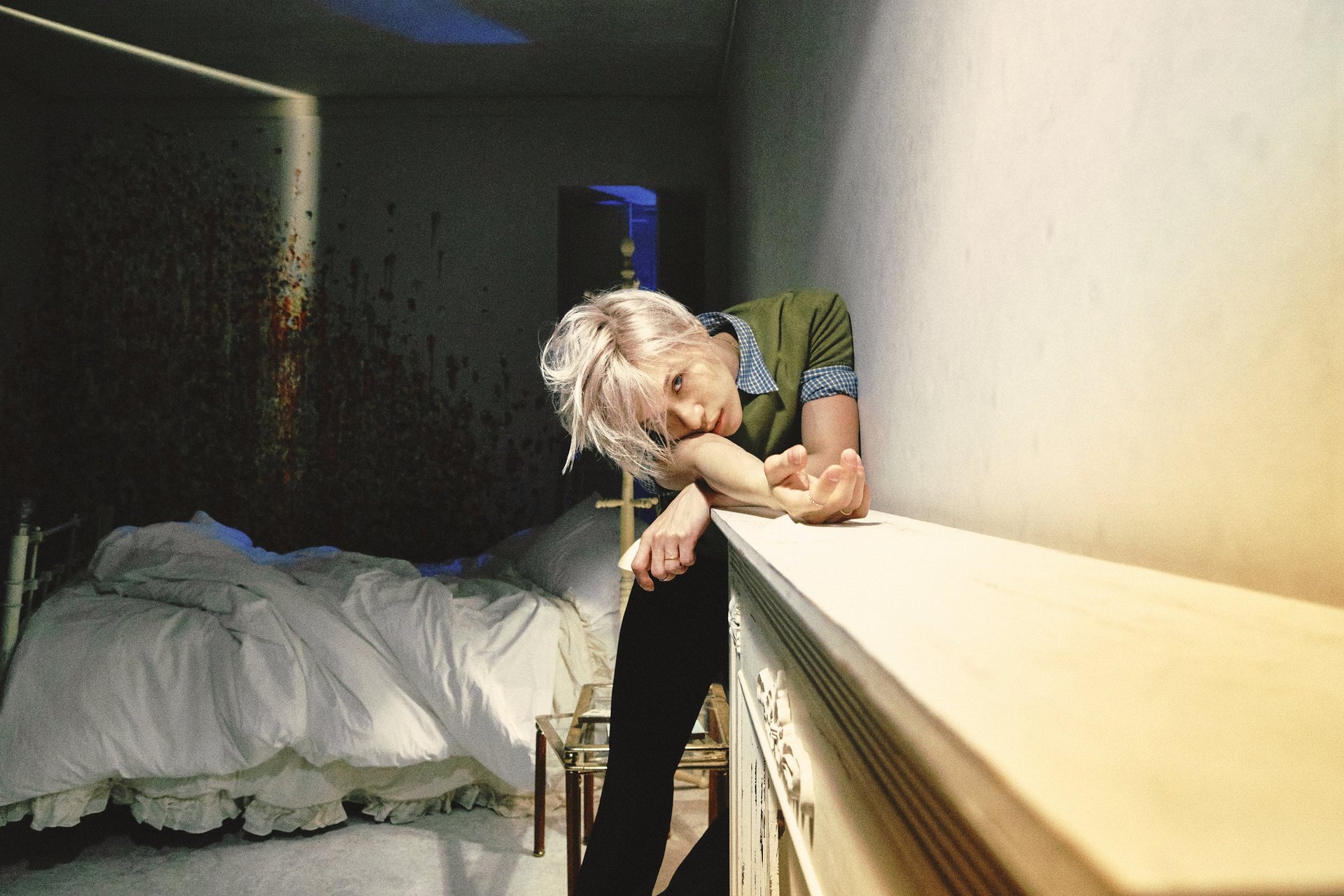
1. Putting His Own Name in the Credits
After ACE, his name first appeared in the credits on the 2016 studio album Press It. The title track “Press Your Number” was written by Bruno Mars and produced by The Stereotypes, and he wrote the new Korean lyrics for it. The album track “Soldier” was the first song he wrote entirely on his own. Across a full album, that one song was still the whole of his share.
Table 1. Where TAEMIN’s involvement widened across his solo albums
| Release | Album | What he did |
|---|---|---|
| 2014 | ACE | His name is not in the credits |
| 2016 | Press It | Korean lyrics for the title track, sole lyricist on “Soldier” |
| 2017 | MOVE-ing | Wrote and composed the title track “Day and Night” |
| 2020 | Never Gonna Dance Again | Took a substantial role in album concept and production |
| 2024 | ETERNAL | Directed the planning and production of the album as a whole |
What matters in this table is not how much he was involved but what kind of involvement it was. “Day and Night,” the title track of the 2017 repackage MOVE-ing, was the first title track he both wrote and composed. Until then his name had been attached to one or two album tracks; from this song onward it was attached to the face of the album. It is a mid-tempo song built around classical guitar and cello, close to the opposite of the hard minimalism of “MOVE,” the original title track on the same album. On the first title track he wrote for himself, he did not reach for the spectacular.
With the 2020 studio album Never Gonna Dance Again, his role moved from the song to the album. The release was split into a prologue single, “2 KIDS,” followed by Act 1 and Act 2, and the three records form a single narrative. “2 KIDS” deals with the clumsy love of childhood, “Criminal” from Act 1 draws a self trapped in a relationship it cannot leave, and “IDEA” from Act 2 traces the destruction of that self and the return to what it originally was. He took part in writing “2 KIDS,” and was involved in the album’s concept and production more deeply than before. Taking on one song and deciding the order of a story told across three records are different kinds of work.
The 2024 mini album ETERNAL was the first album whose planning and production he directed in full. It also arrived on the tenth anniversary of his solo debut. His name was not on the 2014 album; the 2024 album was designed under it.
He never took full control in one step. As he did on his first self-written title track, where he reached for guitar and cello instead of the spectacular, he showed what he wanted through the work itself each time. Taking on an album means setting the direction for something many people make, which meant his judgment had to be something others could follow. The ten years were the time it took to build that explanation.
2. What He Inherited Was a Question, Not an Answer
The group he came from was a team that changed its sound first. It spent 18 years putting the next sound out before the market’s mainstream arrived, and TAEMIN was its youngest member and main dancer. What he carried out of that place, though, was not an answer that said go with this sound. It was closer to a question: should what is already here be accepted as it is?
A question travels further than an answer. He did not aim it at genre alone. The subjects a song would handle, the range of feeling a stage could hold, how many records to split an album across, how to enter a stage, what to wear — every element he could touch became its object.
What matters is that he does not discard what already exists. Preparing “MOVE,” he told Billboard he wanted to break the conventions of what a male performer is supposed to show and what a girl group’s performance is supposed to be. What he actually did was not to abolish those conventions. His own account was that the goal was to find a middle ground where masculine and feminine movement are mixed together. He left the work that stage expression had always set out to do exactly where it was, and re-chose only the method of doing it.
The same approach shows in the feelings he works with. Popular music tends to avoid dark and uncomfortable emotion; he took it as material to be shaped rather than avoided. “Criminal” deals with being trapped in a relationship that cannot be left, “IDEA” with the destruction of a self, and the title of this album, Soft Violence, sets two words that contradict each other side by side. In interviews he has said he does not want to present one-dimensional brightness alone, and that he aims to shape even taboo feelings into something beautiful on stage.
The album as a form did not escape the question either. Splitting Never Gonna Dance Again into a prologue and two acts came from examining the premise that one album should be a single completed package. If dividing it carries the story more precisely, there is no reason not to divide it.
The instinct to put the unfamiliar out first is something he learned where he started. NCT 127, whose early sound drew the same description, sits in that lineage. What TAEMIN did was widen that instinct beyond sound alone, to the full set of decisions an artist gets to make.
The difference in role comes from here. Inside the group, his work was to realize on stage the color the team had chosen. In his solo work, it is to decide what counts as an object of decision in the first place. When we say the artist whose name was missing from the credits became the designer of his albums, it does not mean he wrote a few more songs. It means he moved to the seat where he decides what gets asked again.
3. Nothing on That Stage Is There by Accident
That perspective takes visible form on stage.
A stage is not made of singing and dancing alone. Where the light falls, what structure stands on the floor, what he walks out wearing, which direction he enters from, where a hand rests, how much space is left between one movement and the next — everything an audience meets is a channel that meaning passes through. What separates his stages from others is that these channels are not kept apart.
This is also why “MOVE,” the title track of his 2017 studio album, is cited so often. The choreography was built by Japanese choreographer Koharu Sugawara, and it ran against a moment when male idol group performance had settled into large movements cut off sharply. Small motions in the hips and shoulders, the space between one movement and the next, and where the eyes land carry the song. Even the space left empty is used as a means of delivery. The performance won Best Dance Performance Solo at the 2017 Mnet Asian Music Awards. He had already taken the same category in 2016 with “Press Your Number,” and in 2020 he won Favorite Dance Performance Male Solo with “Criminal.” Three performance awards at the same ceremony.
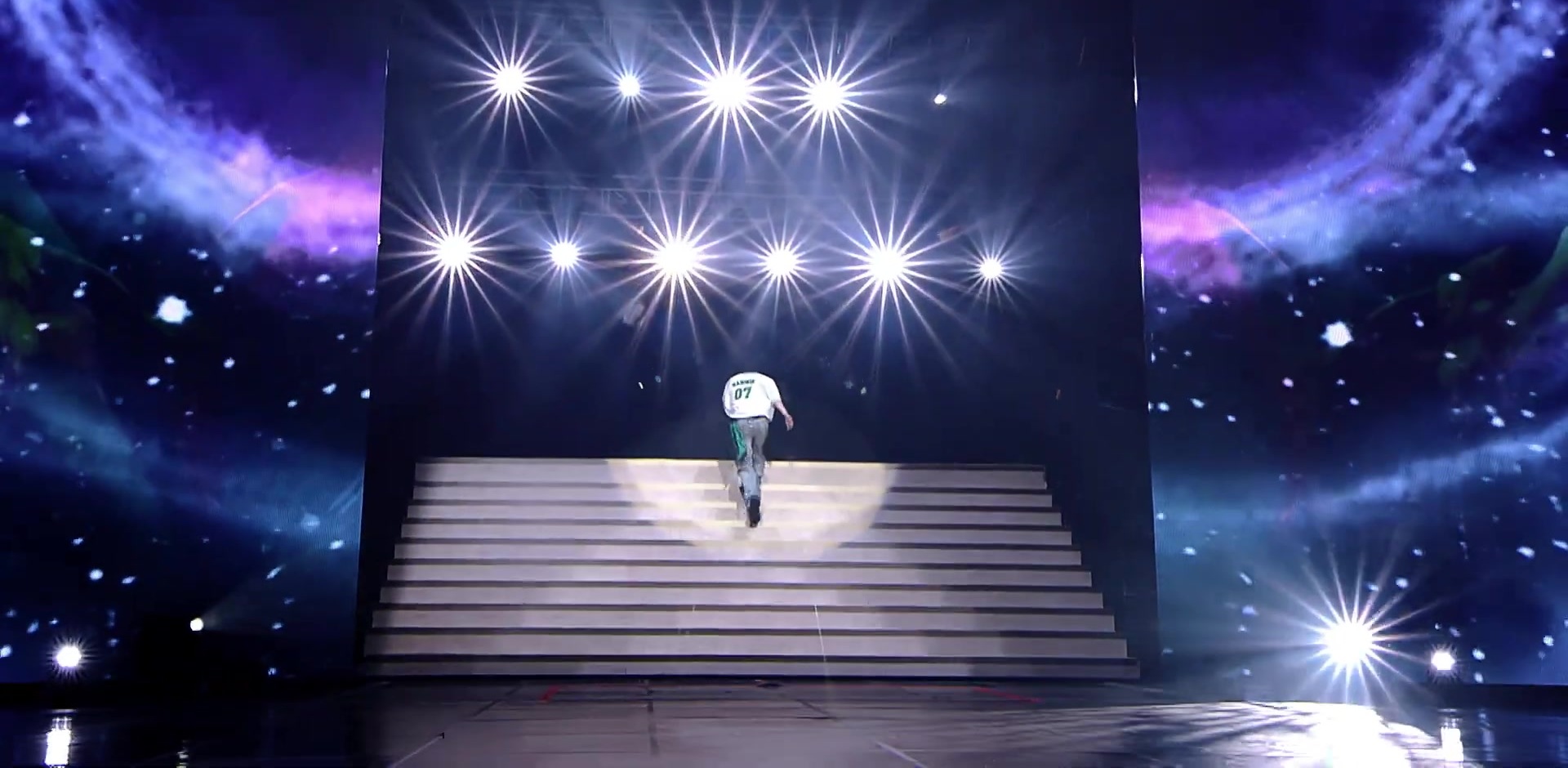
What he designed for “Criminal” was not choreography but a condition. The stage opens with both of his hands bound. The range he can move in is limited from the start, and at the song’s climax he breaks the cord himself. Rather than explaining a relationship that cannot be left, he moved the subject into the state his body was placed in.
In 2023’s “Guilty,” a single hand takes that role. The signature move slips his own hand inside his shirt to touch his throat and jaw. The mood of the song is set by the position of one hand rather than by the whole stage, and the move carried over into challenges other idols joined.
Stage design works the same way. At the opening of METAMORPH, his third solo concert, held in December 2023 at Inspire Arena in Incheon, he appeared hanging upside down from a rotating structure six meters on each side. The structure, which inverts completely, was the first of its kind used at a domestic concert. Instead of adding light, the choice was to flip the direction the audience had been looking in.
His 2026 Coachella set is a case where the way he entered became the message itself. He came out through a structure shaped like an egg, which he said gave form to a passage from Hermann Hesse’s Demian — the line about how a bird must first destroy the only world it has known in order to be born. The stage had already said its part before the first song of the set began.
He decides what he wants to carry first. Then he chooses, from among the elements the audience will meet, the one that will carry it most precisely. That is why the things placed on his stage never say different things.
4. On the Threshold
On April 1, 2026, the exhibition TAEMIN: Performer. Artist. Icon opened at the GRAMMY Museum in Los Angeles. It was the museum’s first solo exhibition devoted to a K-pop solo artist, and it displayed the red and black outfit from his first world tour Ephemeral Gaze, the white outfit from the Veil tour, his in-ear monitors and microphone, an official light stick, and a handwritten note to fans. The museum introduced him as one of K-pop’s most influential and enduring performers and as a trailblazer. The exhibition ran through June 22.
Then, on April 11 and 18, he took the Coachella stage. The six unreleased songs he sang there are on this album. Released on August 31 at 6 p.m. KST, his sixth solo mini album PHASE 1 : Soft Violence carries eleven tracks and leads with two of them, “Float” and “Gooey.” Songs already heard in April arrive officially four months later, and that reversal says what kind of album this is. He did not present something finished. He put something still being made on stage first.
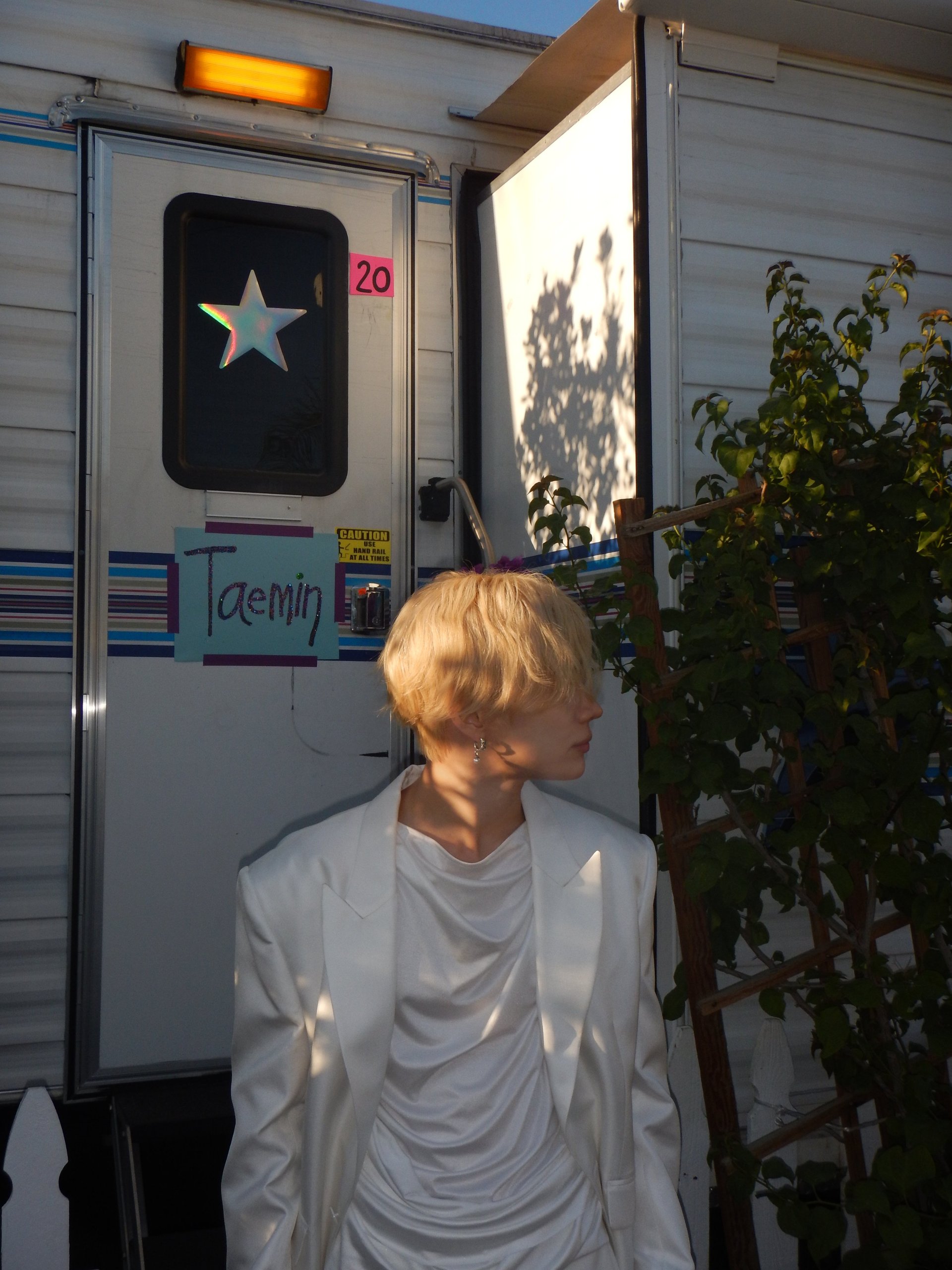
A new world tour begins with the album. 2026-27 TAEMIN WORLD TOUR \<LiMiNaL> opens with three nights at Jamsil Indoor Stadium in Seoul from September 18 to 20, and the first announced leg alone covers twelve cities across three regions, including six cities in the United States, two in Mexico, and stops in Chile and Peru. Given that his first world tour Ephemeral Gaze, which began in Incheon in August 2024 and closed in Seoul in April 2025, ran 37 shows across 29 cities in 20 countries, the first announcement is unlikely to be all of it.
The tour title LiMiNaL comes from the Latin limen, meaning threshold. He has said the name carries the idea that a threshold is not an ending but the moment a change begins. The album title starting at PHASE 1 points to the same place.
Artists who started in a group and walked a long solo road are not without precedent. What Taeyang built over 18 years is one such record. What TAEMIN is saying now, though, is closer to what is still left than to what has been accumulated.
His name was not in the credits of his first album in 2014. The artist who spent ten years building his own standard, and then came to handle everything on a stage with it, has titled the album that followed a first phase. If the word he chose, at the place he arrived after twelve years, means a beginning, then wondering about the next twelve is not something only fans will do.